If you’ve searched for how to support muscle, strength, or body composition during perimenopause or menopause, you’ve probably noticed there’s no shortage of advice. Scroll for even a few minutes and you’ll see just how many strong opinions exist about what women “should” be doing.
You might hear that cardio “spikes cortisol,” that you need to lift as heavy as possible to preserve muscle, or that your protein intake needs to dramatically increase overnight. It can subtly create the sense that midlife requires a very specific formula… and that if you don’t approach it just right, you’re missing something important.
But when we step back and look at the research, the picture is far steadier (and far less extreme) than the headlines suggest.
A lot of what we’re learning about midlife muscle and protein metabolism comes from researchers like Dr. Lauren Colenso-Semple, whose work focuses on exercise physiology and how protein supports muscle health across the lifespan. What I appreciate most about her perspective is that it’s grounded in evidence and refreshingly calm. There are no extremes or scare tactics, her work is built on the body of research.
So let’s dig into to a few hot topics:
Strength Training: Go Big or Go Home?
A common question women ask in midlife is whether they’re “doing the right kind” of exercise. There’s a quiet fear that maybe what used to work no longer does. Or worse, that it’s somehow harmful now.
The truth is, the larger issue isn’t that women are exercising incorrectly. It’s that many of us might benefit from moving more (in any kind of form!)
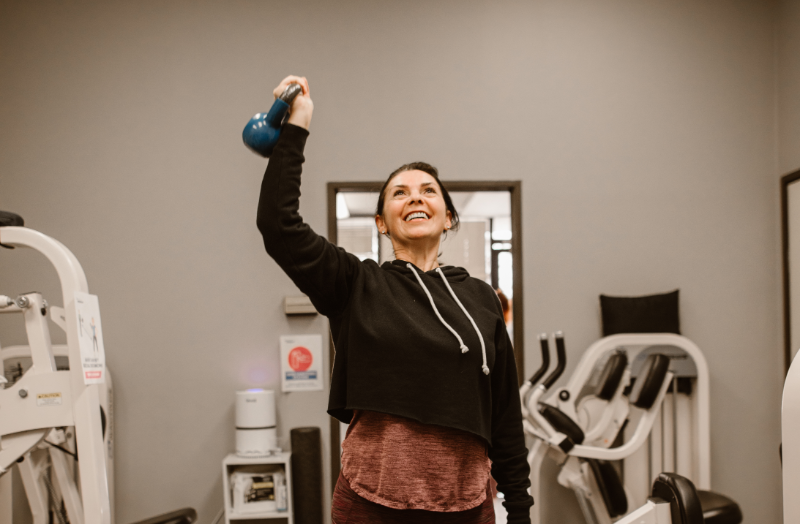
Strength training absolutely becomes more important as we age because it supports muscle mass, bone density, insulin sensitivity, and overall function. But “important” does not mean extreme or even to lift heavy. What is key is for the muscles to be challenged.
That challenge might come from dumbbells at home, resistance bands, Pilates, machines at the gym, or bodyweight exercises. If it feels challenging in a way that is safe and sustainable, you’re stimulating adaptation and that’s the goal!
Another bit of misinformation is that cardio (esp high intensity cardio) raises cortisol. And, that is true! All exercise can do that (it’s normal and fine). The key is to do movement that you enjoy. Because if you enjoy it, you’ll stick with it.
Protein Needs: Personal, Not Panic-Driven
It’s also very common that women come into our office with fear that they aren’t eating enough protein. While they may benefit from more…a lot of people are actually a) eating more protein than they think they are b) taking in sources of higher processed foods (think protein bars and protein chips) to meet their needs – this is both expensive and may be introducing nutrients like saturated fat that we don’t want too much of.
Protein needs are often discussed in grams per kilogram of body weight, but body composition matters too. Someone with more lean muscle mass may require slightly more protein than someone with a higher percentage of body fat. For most women, a range of about 1.2 to 1.6 grams per kilogram of body weight per day is appropriate, but that range isn’t a mandate. It’s a starting point.
Balanced meals that consistently include protein like Greek yogurt, eggs, fish, chicken, tofu, beans, cottage cheese can naturally get you into an appropriate range. Some women prefer distributing protein evenly throughout the day because it helps with hunger and satisfaction. Others may naturally eat more at one meal and less at another. Newer research suggests that total daily intake matters more than perfect distribution.
Flexibility is allowed!
What’s Worth Your Energy
As we get older, we often get wiser. This is not the time in life to micromanage ourselves into fear-based, rigid rules around food and exercise. Aging is inevitable. Muscle mass will shift. Hormones will change. But we are not powerless in that process.
The women we see thrive in midlife are not the ones chasing extremes. They are the ones who commit to steady, sustainable habits that fit their real lives.
If you’re navigating perimenopause or menopause weight gain, trying to understand how much protein you actually need, or wondering how strength training fits into your life, working with a registered dietitian can help clarify the noise.
At McDaniel Nutrition, our team of registered dietitians in St. Louis, Missouri specializes in midlife women’s health, including perimenopause nutrition, menopause support, and body composition changes. We help women build realistic plans around strength training, protein intake, heart health, and metabolic shifts, without extremes or fear-based messaging.
If you’re looking for a St. Louis dietitian for perimenopause or menopause support, we’d love to walk through it with you. Midlife can absolutely be a season of strength, when we stop fighting our bodies and start working with them.